Brewing a pour-over with 15g of coffee is fairly straightforward. But what if you want to make a larger 35g batch to share with someone?
It’s not quite as simple as doubling everything.
With more coffee in your V60, the coffee bed becomes deeper, and water takes longer to pass through. If the grind is too fine or the pouring too aggressive, the drawdown can become slow, potentially affecting the clarity and balance of the final cup.
For this brew, I wanted to find a good balance between bright acidity, natural sweetness, and a clean finish, while preserving the character of the coffee.
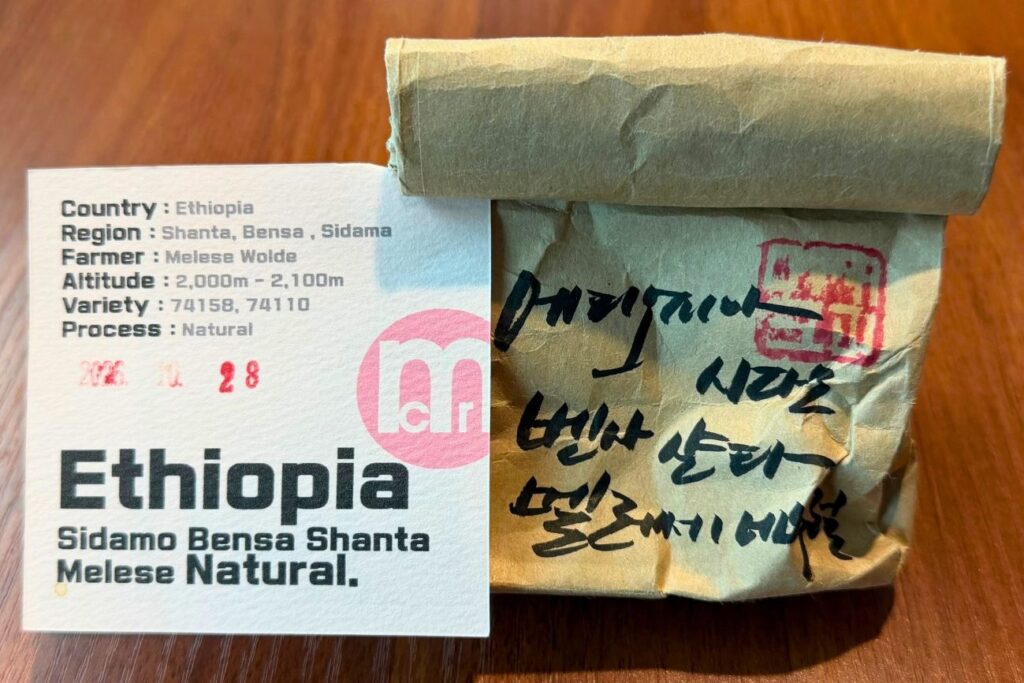
The coffee I’m using today is Ethiopia Sidamo Bensa Shanta Melese Natural, from Shanta in the Bensa area of Sidama, Ethiopia.
This coffee comes from farmer Melese Wolde, who grows coffee at an altitude of 2,000–2,100 meters above sea level. The lot contains two varieties, 74158 and 74110, and is processed naturally.
The combination of its high-altitude origin, specific varieties, and natural processing makes this an interesting coffee to explore. I was particularly looking forward to its floral aromas, fruit sweetness, and delicate character.
Our beans were sourced and roasted by Mark Coffee Roasters in Busan, South Korea, a local specialty coffee roaster worth visiting if you’re exploring the city’s coffee scene.
For this recipe, I’m using the Hario Smart G Pro hand grinder and a Hario V60 02 dripper.
I spent some time experimenting with different grind settings and water temperatures before settling on this recipe. My initial trials at 90°C produced a cup that felt a little hollow and lacked some of the depth I was looking for.
Increasing the water temperature to 93°C made a noticeable difference. I also tested different grind settings, starting at 30 clicks before moving to 28 clicks. I preferred the added depth and balance of the finer setting, with a final drawdown time of approximately 3 minutes and 30 seconds.
Here’s how I brew this coffee for two.
The Recipe Blueprint – Ethiopia Sidamo Bensa Shanta Natural
After several rounds of experimenting with grind size and pouring technique, this is the recipe I settled on for a 35g batch.
| Parameter | My Tested Recipe |
|---|---|
| Country | Ethiopia |
| Region | Shanta, Bensa, Sidama |
| Farmer | Melese Wolde |
| Altitude | 2,000–2,100m |
| Varieties | 74158 and 74110 |
| Process | Natural |
| Roaster | Mark Coffee Roasters, Busan |
| Coffee dose | 35g |
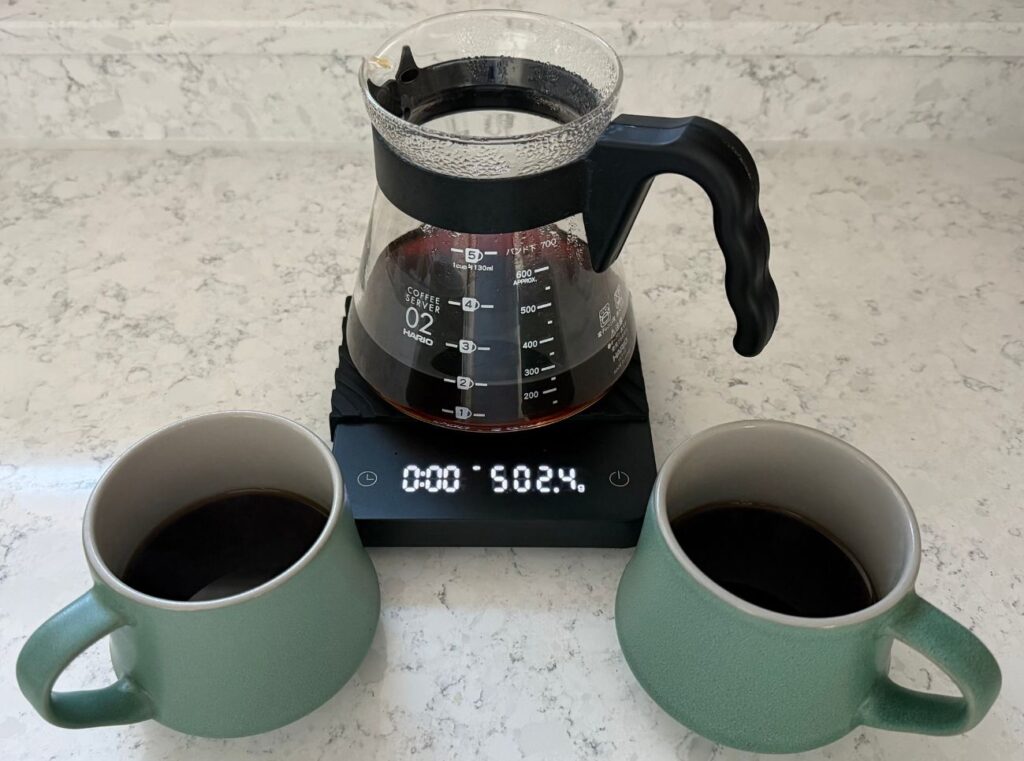
| Total water | 560g |
| Brew ratio | 1:16 |
| Water temperature | 93°C / 199.4°F |
| Dripper | Hario V60 02 |
| Filter | Hario V60 02 White Paper Filter |
| Grinder | Hario Smart G Pro |
| Grind setting | 28 clicks |
| Target brew time | 3:15–3:45 |
| My actual brew time | 3:30 |
The 1:16 ratio is a good starting point for a balanced cup, giving us enough water to bring out the coffee’s sweetness without making it too concentrated.
I settled on 93°C after finding that my initial 90°C brews lacked some of the depth I was looking for. The slightly higher temperature gave me a more satisfying balance of fruit, sweetness, and body.
These settings worked well with my particular beans and equipment. Different water, bean freshness, and roast profiles may require a little adjustment.
Grinder Setup: Hario Smart G Pro
For a larger 35g batch, I prefer starting slightly coarser than I would for a single cup.
The deeper coffee bed creates more resistance as water passes through, so grinding too fine can result in a slow drawdown.
For this particular coffee, I settled on 28 clicks from the fully closed position after testing several grind settings.
My initial test at 30 clicks finished in approximately 3:20, but the cup felt a little light and lacked the depth I wanted. Moving to 28 clicks gave me a slightly longer drawdown of around 3:30, along with a more satisfying cup.
The grounds should look medium-coarse, roughly resembling coarse sea salt. This is only a visual reference, as grind appearance can vary between grinders.
If you’re using the same grinder and coffee, 28 clicks is a good setting to try. However, treat it as a reference rather than a universal setting.
If the final cup tastes a little thin or overly sharp, try going one click finer next time. If it tastes dry or bitter, move one click coarser.
The goal is a steady drawdown and a cup with a good balance of sweetness, acidity, and body.
Step-by-Step: The Four-Pour Method
For this larger batch, I prefer four separate pours rather than continuously adding water.
The idea is to saturate the grounds evenly, build the brew gradually, and avoid unnecessary agitation that could affect the water flow.
1. The Bloom (0:00–0:40)
- Start your timer and pour 105g of water evenly over the coffee grounds.
- Make sure all the grounds are wet, including those around the edges.
- Let the coffee bloom for 40 seconds.
During this time, carbon dioxide released from the freshly roasted beans escapes, helping prepare the coffee bed for the remaining pours.
2. The Second Pour (0:40–1:20)
- At the 40-second mark, begin your second pour.
- Slowly bring the total water weight to 260g.
- Use gentle circular movements, starting near the center and moving toward the edges.
Avoid pouring directly onto the paper filter. Keeping the stream controlled helps distribute the water without creating unnecessary agitation.
3. The Third Pour (1:40)
- At approximately 1:40, begin your third pour.
- Pour steadily, bringing the total water weight to 420g.
- Keep the pour relatively centered and controlled.
This helps maintain a consistent water level while keeping agitation relatively low.
4. The Final Pour (2:30)
- At 2:30, begin your final pour.
- Bring the total water weight to 560g.
- Keep your pouring stream smooth and gentle, then allow the remaining water to drain naturally.
With this setup, the brew finished at approximately 3:30, comfortably within the 3:15–3:45 target window.
Once the water has drained, take a look at the coffee bed. A reasonably flat bed is a nice indication of even water distribution, although the taste in your cup is the real test.
What I Experienced in the Cup
What I enjoyed most about this Ethiopia Sidamo Bensa Shanta Natural was its combination of delicate florals, bright citrus, and a light, tea-like finish.
The Aroma
The first thing I noticed was the floral fragrance. Jasmine and white floral notes stood out, accompanied by a gentle sweetness reminiscent of fresh blueberries.
It was delicate rather than overpowering, making the coffee particularly enjoyable even before the first sip.
The Flavor
Bergamot and ripe apricot were the standout flavors for me.
There was a refreshing citrus brightness, almost like a well-brewed Earl Grey tea, followed by a softer sweetness of red berries and raspberry.
The combination gave the coffee a lovely balance between brightness and fruit sweetness without feeling too heavy.
The Finish and Mouthfeel
What stood out most was the light, tea-like mouthfeel.
The coffee felt clean and delicate, without the heaviness that some naturally processed coffees can have. As I continued drinking, a gentle honey-like sweetness lingered on the palate.
It was this combination of floral aromas, fruit sweetness, and a clean tea-like finish that made the coffee particularly enjoyable.
How the Flavors Change as the Coffee Cools
I always like to take my time with a good pour-over. As the temperature drops, different aspects of the coffee become easier to notice.
- While hot: The jasmine-like floral aromas and bright, bergamot-like citrus acidity are more noticeable.
- As it cools: The apricot and raspberry notes become sweeter and more pronounced, giving the cup a rounder fruit character.
- When cool: The tea-like mouthfeel and gentle honey sweetness become more apparent, leaving a clean and refreshing finish.
I particularly enjoyed how the coffee moved from bright and floral when hot to sweeter and more delicate as it cooled.
Troubleshooting: Fine-Tuning Your Brew
If your brew doesn’t quite taste right, don’t change everything at once. Start with the grind size and make small adjustments.
If the brew takes longer than 4:00
If the coffee also tastes dry, heavy, or bitter, try going one click coarser, from 28 to 29 clicks.
This should allow water to pass through the coffee bed more easily and may help improve the balance of the cup.
If the brew finishes before 3:10
If the coffee tastes thin, hollow, or overly sharp, try going one click finer, from 28 to 27 clicks.
A finer grind increases resistance in the coffee bed and may help extract more sweetness and body.
One final reminder: Brew time is a guide, not a strict rule. A slightly slower brew can still taste excellent, and a quick drawdown doesn’t automatically mean the coffee is under-extracted.
Pay attention to what’s actually in your cup. If it tastes sweet, balanced, and enjoyable, you’ve found a recipe that works.
Enjoy your DailyBrewFix!