You have dialed in your grind size, your water temperature is a precise 93°C, and you are using a high-quality gooseneck kettle. Yet, halfway through your pour-over, the water stalls. The drawdown slows to a painful drip, your total brew time climbs past five minutes, and you are left with a bitter, muddy cup of coffee.
Naturally, you blame your grinder for producing too many fines. But before you go adjusting your burrs, look closer at your filter cone. The culprit might not be your grind at all—it might be a hidden trap in your pack of official Hario V60 paper filters.
Most coffee drinkers assume that a Hario paper is just a Hario paper. In reality, Hario manufactures several radically different versions of their filters across different factories. They look almost identical on the shelf, but they behave completely differently—with certain versions utterly choking large-batch brews.
Here is the breakdown of the hidden Hario paper matrix, why your coffee is clogging, and how to choose the right fit for your daily routine.
Hario V60 Paper Filters – 01 vs 02: Choosing the Right Size for Large Batches
Hario builds its ecosystem around sizing numbers. If you are brewing for just yourself, you can easily bounce between sizes. However, if you are tackling a large-batch brew (like our daily 35g recipe for 2 people), size choice becomes a strict rule:
- The 01 Series (1–2 Cups): Perfect for small, single-cup extractions (12g to 20g of coffee). If you try to fit a 35g coffee bed into a 01 paper, the grounds will sit right up at the rim, leaving you zero physical room to pour water without overflowing.
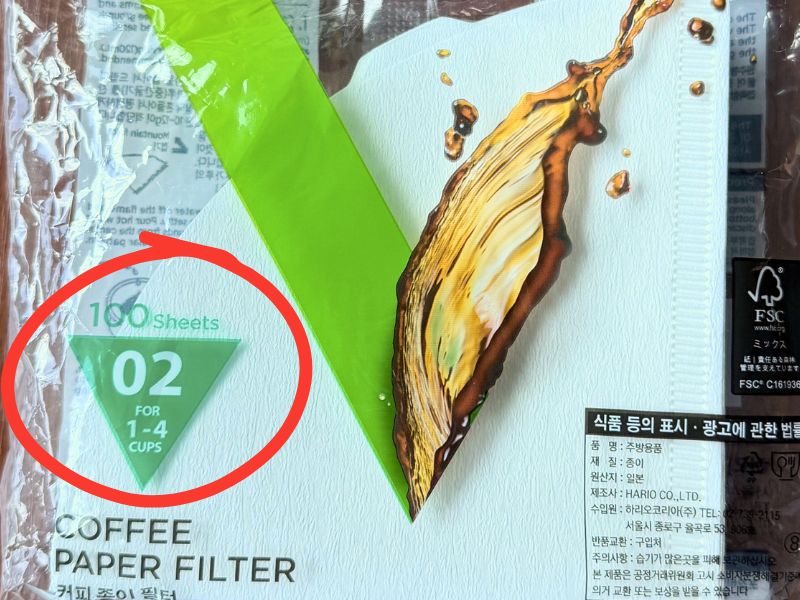
- The 02 Series (1–4 Cups): The absolute sweet spot for multi-person brewing. It provides a deep enough cone to comfortably hold a large 35g coffee bed while leaving plenty of overhead space for high-volume water pours.
The Secret Suffix Matrix: Decoding Hario Flow Rates
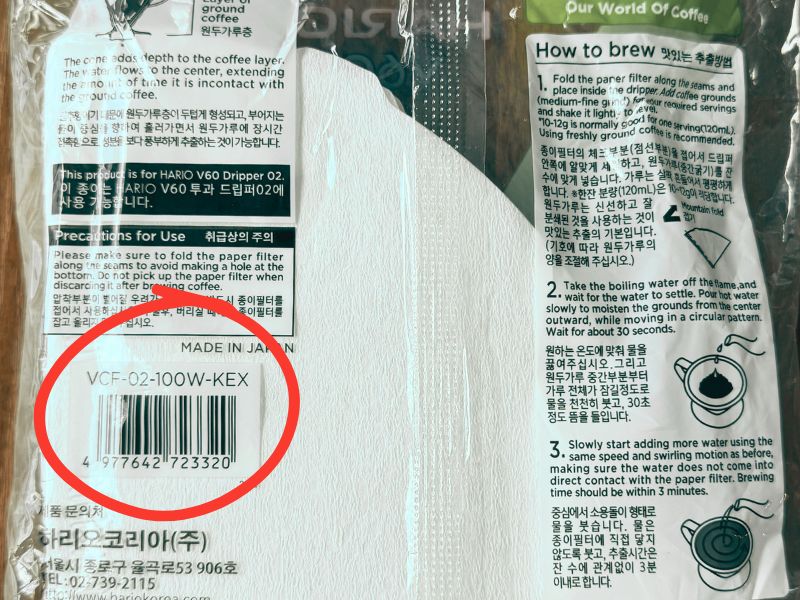
To clear up the confusion, look at the barcode on the back of your packaging. Match your model code to the chart below to find out exactly how your filter is built and how it will perform:
| Model Code | Size & Capacity | Material & Color | Packaging Type | Flow Rate Profile |
| VCF-01-100W / -40W | 01 (1–2 Cups) | Bleached White | Plastic Wrapper | Ultra-Fast (Untabbed) |
| VCF-01-100W-KEX | 01 (1–2 Cups) | Bleached White | Plastic Wrapper | Moderate (Tabbed) |
| VCF-01-100WK | 01 (1–2 Cups) | Bleached White | Cardboard Box | Moderate (Tabbed) |
| VCF-01-100M / -40M | 01 (1–2 Cups) | Unbleached Brown | Plastic Wrapper | Fast-Moderate (Untabbed) |
| VCF-01-100MK | 01 (1–2 Cups) | Unbleached Brown | Cardboard Box | Moderate (Tabbed) |
| VCF-02-100W / -40W | 02 (1–4 Cups) | Bleached White | Plastic Wrapper | Ultra-Fast (Untabbed) |
| VCF-02-100W-KEX | 02 (1–4 Cups) | Bleached White | Plastic Wrapper | Moderate (Tabbed) |
| VCF-02-100WK | 02 (1–4 Cups) | Bleached White | Cardboard Box | Moderate (Tabbed) |
| VCF-02-100M / -40M | 02 (1–4 Cups) | Unbleached Brown | Plastic Wrapper | Fast-Moderate (Untabbed) |
| VCF-02-100MK | 02 (1–4 Cups) | Unbleached Brown | Cardboard Box | Moderate (Tabbed) |
Every Hario code starts with VCF (V60 Coffee Filter), followed by the size (01 or 02), and the sheet count (40 or 100). The real secret to how that paper will flow lies in the letters at the very end of that code:
1. The Ultra-Fast Flow: The “W” Suffix (Japanese Untabbed White)
- The Codes: VCF-01-100W, VCF-01-40W, VCF-02-100W, VCF-02-40W
- The Look: These come in a simple plastic shrink-wrap pack. The paper has no tab on the rim. The texture is noticeably crepey and soft on both sides.
- The Performance: Fast and incredibly consistent. Fines pass through easily without blocking the pores, making it incredibly forgiving for big batches.
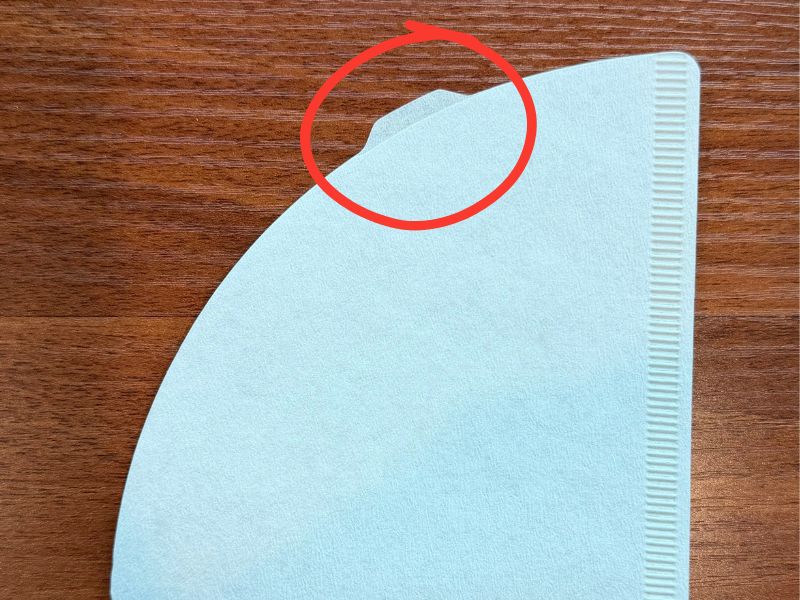
2. The Moderate Flow: The “-KEX” or “-WK” Suffix (Japanese Tabbed White)
- The Codes: VCF-01-100W-KEX / VCF-02-100W-KEX (Plastic wrapped) or VCF-01-100WK / VCF-02-100WK (Cardboard Boxed—the “K” stands for Kbako).
- The Look: Both variants explicitly state “Made in Japan” on the back and feature a prominent pull-tab on the paper rim.
- The Performance: Moderate. This paper has a slightly tighter structural weave from Hario’s secondary Japanese factory. It traps more micro-fines, meaning your drawdown will naturally take 20 to 30 seconds longer than the untabbed plastic-wrapped versions.
3. The Clogger: The “-H” Suffix (European / Holland Tabbed)
- The Code: VCF-02-100W-H
- The Look: Marked with a “Made in Holland” stamp on the back of the bag or box. The paper feels smooth, distinctly thick, and almost cardboard-like.
- The Performance: Extremely Slow. This paper is significantly thicker and less porous. If you are pushing a large batch (like a 35g double-serve), this paper acts like a brick wall, causing severe stalling.
White vs Brown V60 Papers: Does It Affect the Taste?
When deciding between bleached white papers and natural unbleached brown papers, the differences extend beyond simple flow rates to affect the actual flavor clarity of your brew.
The Natural Flow: The “M” or “MK” Suffix (Japanese Untabbed Brown)
- The Codes: VCF-01-100M, VCF-01-40M, VCF-02-100M, VCF-02-40M (Plastic wrapped) / VCF-01-100MK, VCF-02-100MK (Boxed).
- The Look: Classic natural brown wood pulp filters, featuring an untabbed edge in the plastic bags, and a tabbed edge in the boxed “MK” versions.
- The Performance: Fast to Moderate. The raw, unbleached wood fibers have a slightly rougher surface texture than bleached white papers. They trap fines a tiny bit quicker than the original white untabbed papers, but they rarely stall out completely.
The Golden Rule for Brown Papers
If you prefer unbleached brown papers, your rinsing step is non-negotiable. Place the filter in your V60 cone and pour at least 200–300ml of boiling water straight through it into your server (and dump that water out!) before adding your coffee grounds. This washes away the loose paper dust that tastes like wet cardboard.
The Data: How Much Difference Does a Paper Make?
To prove it isn’t just a placebo effect, let’s look at a standard benchmark test. Using the exact same coffee bean, the exact same grind size on a Hario Smart G Pro, and an identical pouring structure:
- Untabbed White Paper (-W): Total Drawdown Time = 3:15 (Clean, vibrant, high clarity)
- Untabbed Brown Paper (-M): Total Drawdown Time = 3:30 (Good body, requires heavy rinsing)
- Tabbed Japanese Paper (-KEX / -WK / -MK): Total Drawdown Time = 3:40 (Balanced, slightly heavier body)
- Holland Tabbed Paper (-H): Total Drawdown Time = 4:45+ (Stalled, bitter, over-extracted)
In large 35g batches, the weight of the water compresses the deep coffee bed. Tighter paper weaves trap micro-fines right at the bottom seam of the cone, creating an immediate bottleneck.
How to Fix Your Daily Brew
If you are tired of inconsistent brew times and muddy cups, here is how to take control of your daily pour-over workflow:
1. Match Your Grind to Your Packaging
If you just opened a fresh package of tabbed papers (like the KEX or WK) and notice your large 35g batch is running a bit slow, don’t throw them away. You can easily adjust your technique:
- Coarsen the Grind: Go 1 to 2 clicks coarser on your grinder than your baseline to open up the coffee bed.
- Reduce Agitation: Stop swirling your brewer aggressively during the bloom or final pour. Heavy swirling forces the micro-fines to migrate to the bottom of the cone, where the tabbed paper will immediately trap them and choke the flow. Keep your pours gentle and linear.
2. Switch to Fewer Pours
Instead of a 4- or 5-pour method, use a 2-pour method (Bloom + one continuous, steady pour) to keep the water level high and create enough hydrostatic pressure to force the water through the paper.
The Verdict
The next time your Hario V60 stalls, don’t immediately blame your pouring technique or your grinder. Take a close look at the barcode on the back of your pack. Knowing your factory suffix is the missing link to getting a repeatable, perfect extraction every single morning.
Get to know futher about Hario V60, read A Beginner’s Guide: How to Use the Hario V60 Pour-Over