Bad grind, bad coffee. That’s it. That’s the whole secret nobody wants to say plainly.
You can have great beans, a beautiful Chemex, perfect water temperature, and a carefully timed pour. If your grinder is producing uneven, inconsistent grounds, you’re fighting the brew the entire way. Pour over is particularly unforgiving on this front, it exposes grinder flaws faster than almost any other method.
I’ve leaned on a lot of grinders along the way. Some I loved. Some I quietly retired. Here are the three I’d actually recommend for pour over brewing right now, and the honest reasons why.
Before the List: What Pour Over Actually Needs From a Grinder
Most grinder roundups skip this part and go straight to rankings. I won’t, because understanding this makes the list actually useful to you.
Pour over brewing is a slow, deliberate extraction. Water flows through the grounds by gravity, and every particle it touches either gives up flavor too fast or too slow. The goal is uniform extraction, and that starts with uniform grind size.
What this means practically:
- You need a grinder that produces consistent particle size with minimal “fines” — the powdery dust that clogs filters and causes over-extraction
- Grind setting adjustments need to be fine enough to dial in your specific beans (light, medium, dark roasts each want slightly different sizes)
- The grinder should handle medium to medium-fine ranges reliably — that’s where most pour over brewing lives
A grinder that excels at espresso isn’t automatically good for pour over. And a grinder that’s perfect for French press can be too coarse and inconsistent for V60. Pour over sits in its own specific zone, and it rewards grinders that are built for clarity and particle uniformity.
If you want to understand how grind size affects extraction more deeply, the grind size guide on this site is the clearest explanation I’ve found.
The 3 Best Burr Grinders for Pour Over Coffee
1. Baratza Encore ESP – Best Overall for Most Home Brewers
Price range: $170-$200
Burr type: Conical
Best for: Daily home pour over brewers who want reliability without fuss
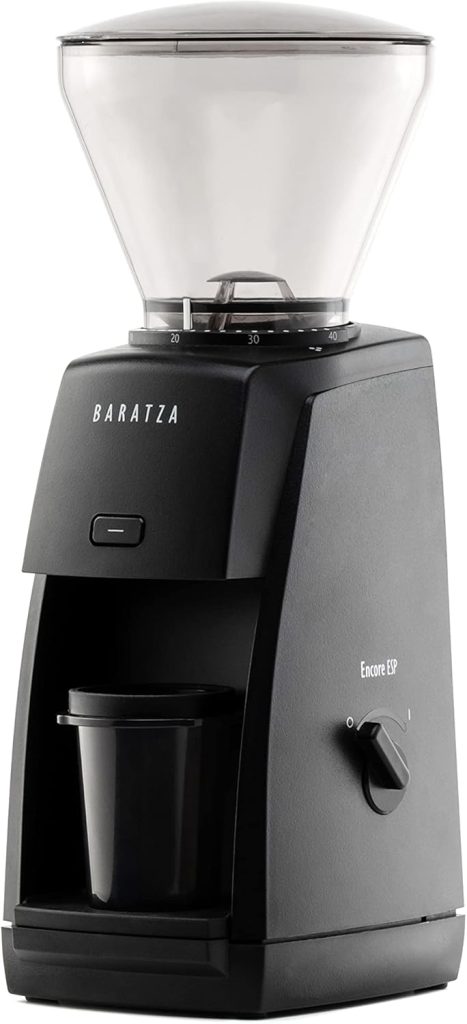
The Encore has been the standard recommendation for home pour over for years. The newer ESP version sharpens that reputation with improved espresso-range settings — but for pour over brewers, what matters is that the medium-to-medium-fine range is excellent.
Why it works for pour over:
- 40 grind settings give you genuine room to dial in across different beans and roast levels
- The conical burr produces a clean, consistent grind in the range pour over needs most
- Low retention – very little ground coffee stays trapped inside between brews
- Simple to use. There’s no learning curve. You set the number, press the button, done.
It’s not the most exciting grinder on this list. It won’t win design awards. But it will grind consistently every morning for years without complaining. For most people brewing one or two cups of pour over daily, that’s exactly what matters.
The honest downside: Static can be an issue, particularly in dry climates. A quick spray of water on the beans before grinding — a trick called the Ross Droplet Technique — fixes it in about two seconds. It becomes habit fast.
So what? The Encore ESP is the grinder I’d recommend to someone who wants to stop thinking about their grinder and start enjoying their coffee. It earns its place on the counter without demanding attention.
2. 1Zpresso X-Ultra – Best Manual Grinder for Pour Over
Price range: $159-$180
Burr type: Conical (stainless steel, 48mm)
Best for: One or two cup brewers, travel setups, people who like quiet mornings
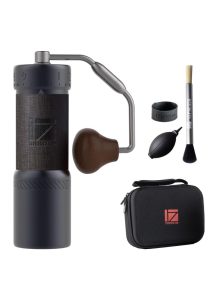
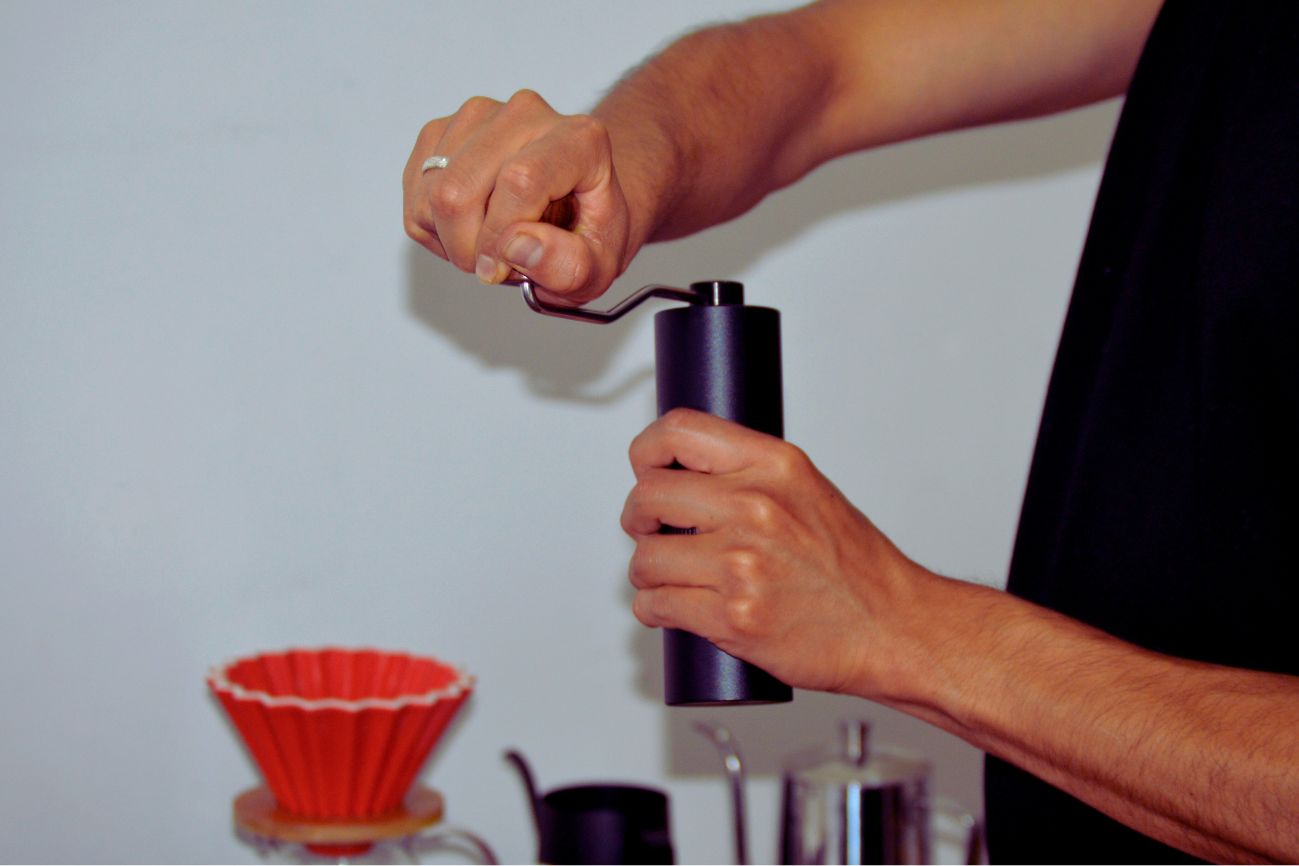
Manual grinders have a reputation problem. People assume they’re a budget compromise. They’re not — at this price point, you’re often getting better burr quality than many electric grinders in the same range.
The JX-Pro specifically is built for the medium-to-coarse range, which makes it an excellent match for pour over, Chemex, and drip. Its adjustment system uses numbered clicks, which means you can repeat your settings reliably from one brew to the next.
Why it works for pour over:
- The 48mm conical stainless burrs produce genuinely clean, uniform grounds — you can see the consistency when you tap the grinds out
- External adjustment ring with clear click stops means you can dial in precisely and come back to the same setting every time
- Zero static. No grounds flying around your counter.
- Quiet. Completely quiet. No motor noise, no whirring, just the soft sound of grinding.
- Grinds enough for a single V60 brew in about 45-60 seconds of easy cranking
The honest downside: It’s manual. That’s not a flaw, but it is a reality. If you’re making coffee for two people every morning or you’re always rushing, the effort adds up. This grinder suits a slower, more intentional brewing routine. If that’s not you, go with the Encore.
So what? The JX-Pro delivers electric-grinder quality in a portable, silent, zero-static package. If you brew one or two cups of pour over daily and you value a quieter morning routine, this is the most underrated grinder on this list. It also travels exceptionally well.
For more on when a manual grinder makes sense for your setup, the manual vs electric grinder comparison walks through it properly.
3. Oxo Brew Conical Burr Grinder – Best Entry Point Under $100
Price range: $80-$100
Burr type: Conical (stainless steel, 40mm)
Best for: Newer home brewers, smaller budgets, people upgrading from blade grinders
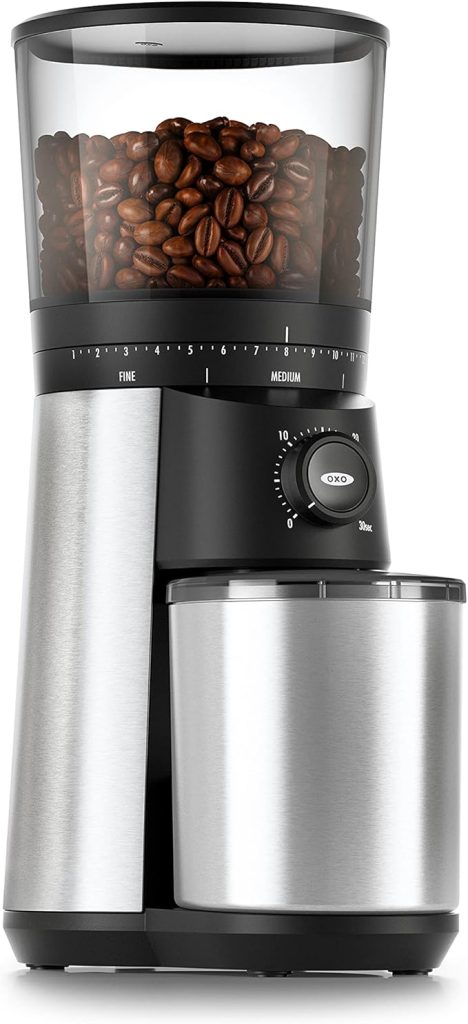
Most grinders under $100 disappoint. They’re either too imprecise, too messy, or they make a sound like a small engine failing. The Oxo Brew is the exception in this price range.
It won’t out-perform the Encore or the JX-Pro. But for what it costs, it gives you a genuinely usable medium grind range for pour over, a simple interface, and build quality that holds up to daily use far better than most competitors at this price.
Why it works for pour over:
- 15 settings plus a micro-adjustment dial give you enough range to work with different beans
- The conical stainless burrs produce reasonably consistent grounds in the medium-to-medium-fine range where pour over lives
- Single-dose button for precise dosing — useful for pour over where weight-to-water ratio matters
- Compact footprint. It doesn’t eat counter space.
- Genuinely quiet for an electric grinder
The honest downside: At the finer end of its range, consistency drops noticeably. If you’re brewing very light roasts that benefit from a finer grind, you’ll feel the limitation. For medium and medium-coarse pour over, it performs well above its price. For finicky light roast V60 recipes, it starts to show its ceiling.
Also worth knowing: retention is slightly higher than the Encore, meaning more grounds stay in the chute. A quick tap or brush after grinding keeps it manageable.
So what? If you’re coming from pre-ground coffee or a blade grinder and want to understand what a proper burr grinder does for your pour over without spending $170+, the Oxo Brew is the right first step. It will make your coffee meaningfully better. When you’re ready to go further, you’ll know what to upgrade toward.
How to Choose Between These Three
Here’s the simple version:
If you brew one cup, value quiet mornings, or travel with your setup: JX-Pro
If you brew daily for yourself or two people and want the most reliable long-term choice: Baratza Encore ESP
If you’re newer to fresh grinding, or your budget is under $100: Oxo Brew Conical Burr
The grinder you’ll actually use every morning is better than the grinder that sits on your counter because setup feels annoying. Match the pick to your real routine, not your ideal one.
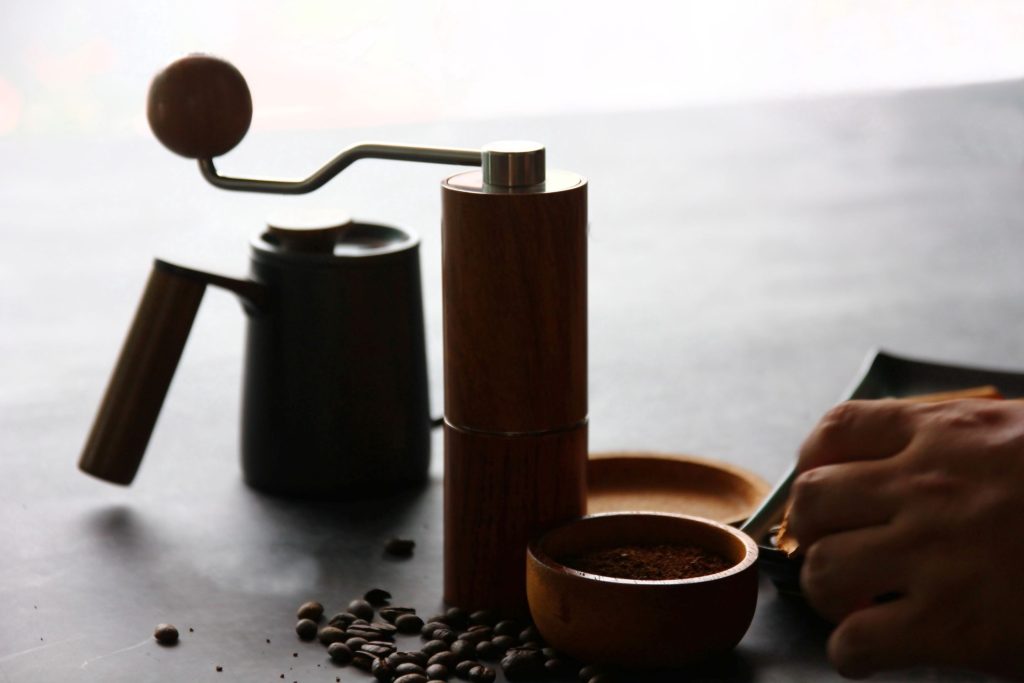
What These Grinders Have in Common (And Why It Matters)
All three share the fundamentals that pour over brewing actually needs:
- Conical burr design — cleaner grind, lower heat, less static than flat burrs at this price range
- Adjustable in the medium-to-medium-fine range — where pour over extraction is most sensitive
- Low enough fines to avoid filter clogging and over-extraction
- Consistent enough that when your cup tastes off, you can trust the grinder and look elsewhere — at your water temperature, your ratio, your pour technique
That last point matters more than people realize. A good grinder removes one variable from the equation. When you trust your grind, troubleshooting becomes simpler.
The Grinder Is the Foundation, Not the Finishing Touch
Most people buy their brewer first and treat the grinder as an afterthought. That’s the wrong order.
Your pour over brewing method only performs as well as the grind feeding it. A $20 V60 with a great grinder will consistently outperform a $60 Chemex fed by a blade grinder. That’s not theory. It’s just extraction physics.
If you’re building a home setup from scratch, put the most thought — and the most budget — into the grinder first. Everything else follows from there. The beginner coffee setup guide lays out the right order to build a home pour over station if you want a clear starting point.
And if you’re still deciding between manual and electric more broadly, that full comparison is worth reading before you commit.
Final Thought
You don’t need the best grinder ever made. You need a burr grinder that grinds consistently in the range your pour over needs, fits your counter, fits your routine, and doesn’t make you dread using it.
Any of these three will do that. Pick the one that matches how you actually brew.
That’s it. Go make a better cup.